Jobs where you pay to get paid
Last reviewed:
A message on WhatsApp, Telegram or by text offers flexible work from your phone: rating products, liking videos or “boosting” apps, for good daily pay. The first tasks really do pay a little. Then a “combination task” puts your account into the negative, and you must top up your own money, often in crypto, to unlock your earnings. Each top-up leads to another. The earnings are never paid out.
What it looks like
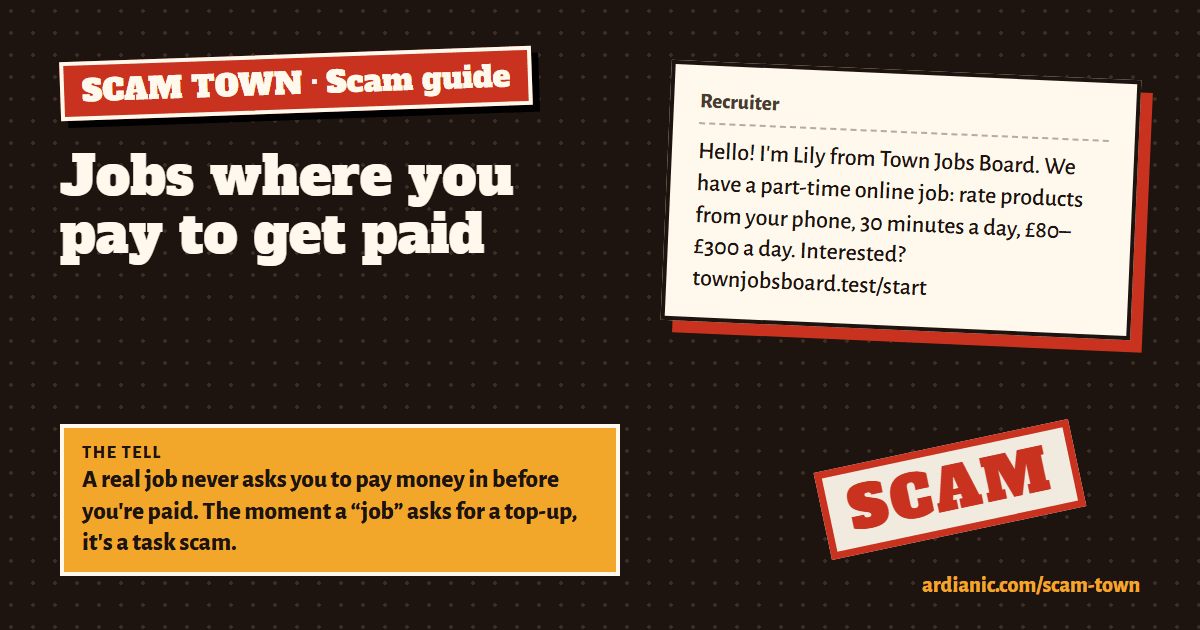
Hello! I'm Lily from Town Jobs Board. We have a part-time online job: rate products from your phone, 30 minutes a day, £80–£300 a day. Interested? townjobsboard.test/start
A made-up example. Every name, number and link here is fictional.
The tell
A real job never asks you to pay money in before you're paid. The moment a “job” asks for a top-up, it's a task scam.
Other signs
- You were contacted out of the blue, often by a friendly recruiter on WhatsApp or Telegram.
- Pay that's far too high for easy work.
- Small early payouts to win your trust.
- A balance on a website that goes negative and must be topped up, often in crypto.
- A group chat full of “colleagues” celebrating their earnings.
What to do
- Stop paying, even if it means losing what you've put in. Paying more never unlocks it.
- Don't send ID documents or bank details.
- Report it, and keep the chats and payment records.
If you already replied, tapped or paid
- Call your bank straight away, on the number on your card (or 159 in the UK). Banks can sometimes stop or recover a payment if they hear quickly.
- Change any password you typed in, on the real site, and turn on two-step sign-in.
- Report it (below), and keep the messages and receipts.
- Be careful of anyone who then offers to get your money back for a fee. That is a second scam.
- Don't feel ashamed. Scams are written by professionals and fool careful people every day.
Report it
- In the UK: forward scam texts free to 7726, and scam emails to [email protected].
- Report fraud at reportfraud.police.uk or call 0300 123 2040 (in Scotland, call Police Scotland on 101).
- Elsewhere: your country's police or consumer protection service.
Sources
The advice here follows these official UK pages:
- Citizens Advice: Check if something might be a scam
- FCA: Protect yourself from scams
- Report Fraud (police)
Practise spotting it
In Scam Town you get letters, texts and calls like these, decide which are real, and see the tell after every answer. You can also build scams yourself from ready-made pieces, which is the fastest way to learn how they work. It's free and plays in your browser.
Play Scam Town