“We've changed our bank details”
Last reviewed:
You're due to pay someone you know: a builder, a landlord, a solicitor for a house deposit, a supplier. An email arrives, apparently from them, saying their bank account has changed and to use the new details. Sometimes the scammer has broken into the real email account and replies inside a genuine conversation. The new account is the scammer's, and the money is usually gone before anyone notices.
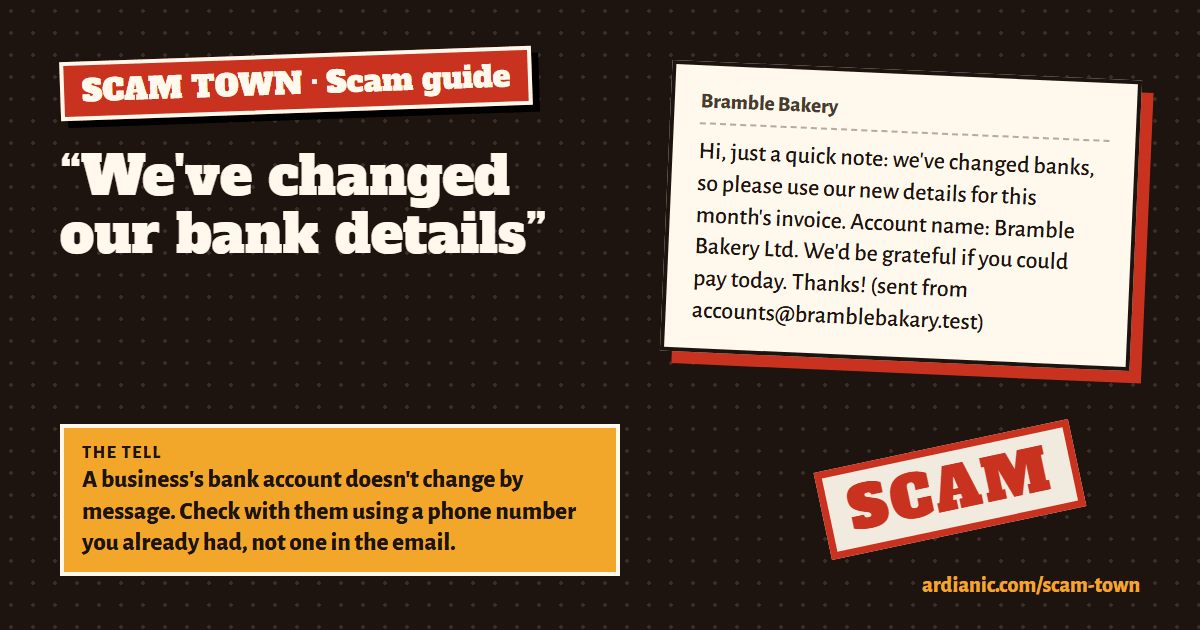
What it looks like
Hi, just a quick note: we've changed banks, so please use our new details for this month's invoice. Account name: Bramble Bakery Ltd. We'd be grateful if you could pay today. Thanks! (sent from [email protected])
A made-up example. Every name, number and link here is fictional.
The tell
A business's bank account doesn't change by message. Check with them using a phone number you already had, not one in the email.
Other signs
- New bank details, especially just before a big payment.
- The sender's address is one letter off, or replies go to a different address.
- Pressure to pay today, or a reason why they can't take a call.
- A name on the account that doesn't quite match the business.
What to do
- Call the person or business on a number you already had (from an old invoice, the contract or their website), and confirm the details out loud.
- For a large payment, send a small amount first and confirm it arrived.
- If you've already paid, call your bank at once. The faster they act, the better the chance of stopping it.
If you already replied, tapped or paid
- Call your bank straight away, on the number on your card (or 159 in the UK). Banks can sometimes stop or recover a payment if they hear quickly.
- Change any password you typed in, on the real site, and turn on two-step sign-in.
- Report it (below), and keep the messages and receipts.
- Be careful of anyone who then offers to get your money back for a fee. That is a second scam.
- Don't feel ashamed. Scams are written by professionals and fool careful people every day.
Report it
- In the UK: forward scam texts free to 7726, and scam emails to [email protected].
- Report fraud at reportfraud.police.uk or call 0300 123 2040 (in Scotland, call Police Scotland on 101).
- Elsewhere: your country's police or consumer protection service.
Sources
The advice here follows these official UK pages:
Practise spotting it
In Scam Town you get letters, texts and calls like these, decide which are real, and see the tell after every answer. You can also build scams yourself from ready-made pieces, which is the fastest way to learn how they work. It's free and plays in your browser.
Play Scam Town